


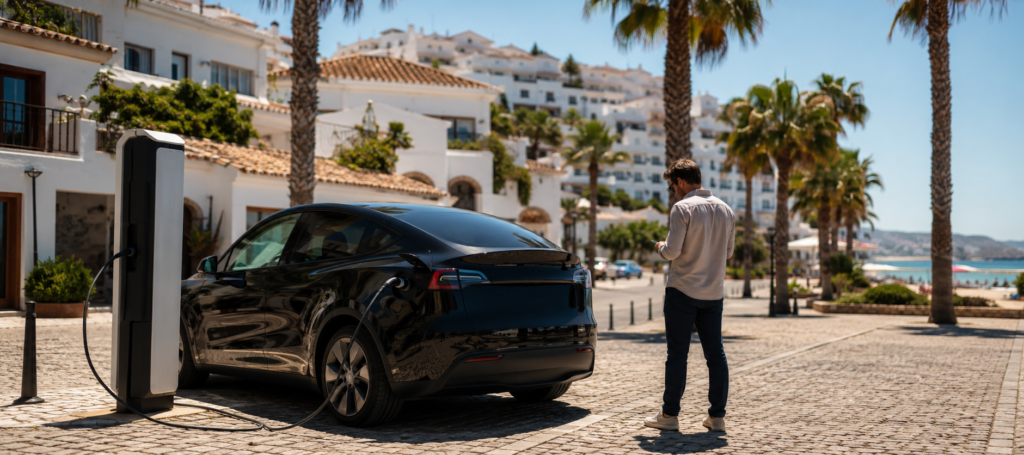
Spain’s tourism sector had a record year in 2025, with international arrivals passing 97 million, and the country is using that momentum to push its transport sector toward electric power. For visitors to the Costa Blanca, the shift is starting to show up in an unexpected place: not just in rental car fleets, but in the small, independent operators who move tourists around once they’ve landed.
A national shift, now reaching the coast
The numbers behind Spain’s EV transition are hard to ignore. Electrified vehicles made up around 18% of the Spanish car market through August 2025, a sharp rise from the year before, and EV sales volumes grew 185% between 2021 and 2023 alone, with a further 34.5% increase in 2024. Much of that growth has been driven from the top: the government’s Plan Auto 2030 aims for electrified vehicles to represent 95% of vehicles produced in Spain by 2035, backed by billions in state investment across the supply chain.
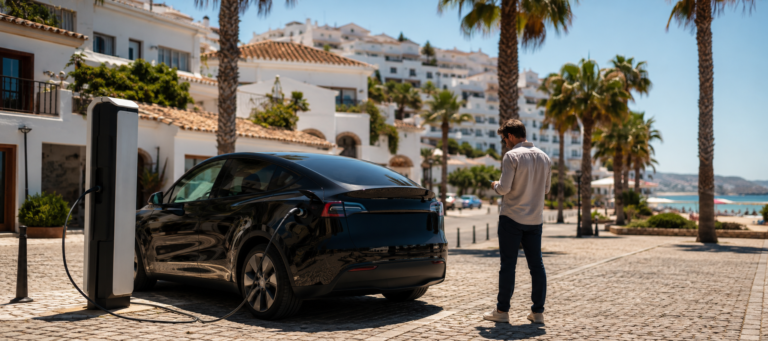
Rental fleets were among the first to feel the shift. Nearly 20% of Spain’s new rental fleet in 2026 is now made up of battery electric vehicles, with models like the Tesla Model 3 becoming a familiar sight on Spanish roads. That’s a meaningful change for a country whose tourism economy runs, in large part, on getting visitors from an airport to a hotel, a villa, or a golf course.
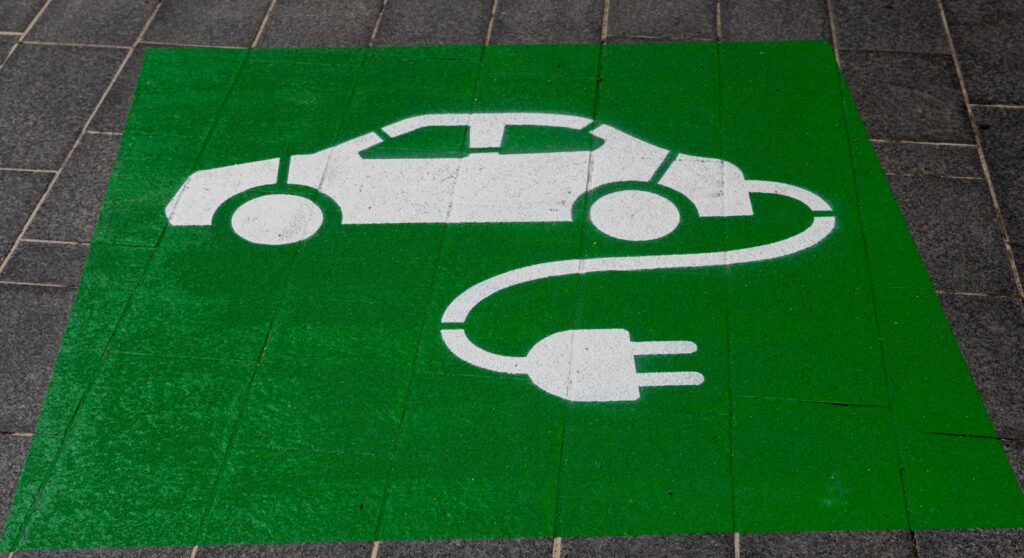
None of it works, though, without somewhere to charge. Spain had more than 30,000 public charging points as of 2025, with over a billion euros in further investment planned, and coastal tourist towns are increasingly seen as a natural fit for destination charging, alongside hotels, airports and heritage sites. For a region like the Costa Blanca, where tourism is the backbone of the local economy, that infrastructure push matters as much as the vehicles themselves.
What it looks like at ground level
The interesting part of this story isn’t really the big rental chains, it’s the smaller operators who are following the same path on a much more local scale. Along the Costa Blanca, a growing number of independent car hire firms, villa management companies, and private transfer services have started replacing combustion vehicles with electric ones as they renew their fleets, often for the same reasons the national data points to: lower running costs, fewer moving parts to maintain, and a growing number of guests who simply expect it.
Costanova Transfer, a private transfer company based in Benidorm, is one example. The company runs fixed price, private transfers between Alicante Airport, Alicante’s RENFE train station, Valencia Airport, and towns across the Costa Blanca, and its fleet is entirely electric, currently a mix of Tesla Model Y and Model 3 vehicles. It’s a small operation by the standards of the big rental chains, but it reflects the same underlying pattern: a tourism-facing business built around daily short trips, for which electric power is a practical fit rather than a marketing exercise.
That’s a pattern likely to repeat. Short, predictable routes, an airport to a coastal town, one hotel to another, are close to the ideal use case for an electric vehicle. There’s little range anxiety involved in a 50 to 150 kilometre trip along a coastline that’s steadily adding charging points, and the quieter cabin and smoother ride tend to land well with tourists arriving after a flight.
Why it matters beyond one region
The Costa Blanca isn’t unique here, similar shifts are underway in other Spanish tourist regions, but it’s a useful case study precisely because it’s not an obvious EV early-adopter market in the way Madrid or Barcelona might be. It’s a coastline built on package holidays, retirees, and second-home owners, not tech enthusiasts. If electric vehicles are becoming the default choice for small tourism operators there too, it says something about how far the underlying economics, not just the incentives, have shifted.
The travel sector is watching this shift closely, since electric transportation is increasingly seen as one of the forces reshaping tourism across Europe. For now, the clearest evidence of that isn’t in a government report. It’s in the quiet, battery powered cars now waiting at arrivals halls up and down the Spanish coast.