


There is a moment every operator in the private transfer business knows well, even if they have never named it.
A potential customer has found your website. They have read enough to feel confident. They have decided, at least provisionally, that they want to book. And then they click on the booking button.
What happens in the next three to five seconds determines whether that customer completes a reservation or quietly navigates away and books with someone else. The research is unambiguous on this point. In e-commerce broadly, and in travel booking specifically, the gap between intention and completion narrows or widens almost entirely based on what the customer encounters the moment they try to act on their decision. Friction kills conversions. Simplicity closes them.
The private transfer industry has known this abstractly for years. Putting it into practice is another matter entirely.
The Booking Form Problem
Ask any operator in the chauffeur and private transfer sector what their single biggest operational challenge is and you will get a range of answers: driver recruitment, fuel costs, insurance, surge pricing from rideshare competitors. Ask their marketing teams the same question and a different answer emerges with striking consistency: abandoned bookings.
The customer arrived. The customer was interested. The customer left without completing a reservation.
The reason, in the vast majority of cases, is not price. Price sensitivity in the private transfer market is real but overstated as a primary dropout driver. Customers who have self-selected into a premium, pre-booked transfer — rather than opening a rideshare app — have already made a psychological commitment to paying more than the cheapest available option. They are not abandoning their booking because they found a cheaper competitor in most cases. They are abandoning it because the process of completing it was more complicated than they expected.
The industry-standard booking form has evolved over two decades in ways that have not always served the customer. Fields that were added for operational reasons — vehicle preference sub-categories, luggage count broken into carry-on and checked separately, return journey details embedded in the initial booking flow, account registration requirements before checkout — each one added in isolation with a perfectly sensible justification, accumulate into an experience that feels like form-filling for its own sake.
The customer who needs to get from an airport to a hotel does not want to make seven decisions before they can confirm. They want to make three: where they are coming from, where they are going, and when. Everything else is either secondary or should be handled after the booking is confirmed, not before.
What Intuitive Actually Means
The word intuitive is used so freely in technology and UX circles that it has lost most of its precision. In the context of a transfer booking system, it means something quite specific: the customer should never have to think about what to do next.
This is harder to achieve than it sounds. The default state of a booking form is a series of questions the business needs answered, presented in the order that makes sense to the business. An intuitive form, by contrast, is structured around the mental model of the customer — the sequence of decisions they naturally want to make, the way they think about their journey, the language they use when they describe what they need.
Consider the difference between a form that asks for pickup date, pickup time, pickup location, drop-off location, number of passengers, number of bags, vehicle class, account creation, payment details — presented as ten separate steps before a price is shown — versus a form that asks for three inputs, shows a price immediately, and handles everything else in a single confirmation screen.
The second form is not less rigorous than the first. It asks for the same information. It collects the same data. The difference is in sequencing, in what is visible when, and in how many moments of uncertainty the customer experiences between the decision to book and the confirmation that the booking is made.
Speed matters independently of simplicity. Studies from Google’s travel research consistently show that every additional second of page load or form transition time reduces conversion rate measurably. In mobile environments, where a substantial proportion of travel bookings now originate, this effect is amplified further. A customer booking a transfer from their phone in the waiting lounge before a flight does not have the patience for a multi-step checkout that loads slowly between pages. They will close the tab and send a WhatsApp message instead.
Which raises a point that deserves its own examination.
The Rise of Conversational Booking
One of the more counterintuitive developments in the private transfer sector over the past several years is the growth of WhatsApp as a primary booking channel, particularly in emerging and mid-sized markets where the professional transfer industry has not yet fully digitized.
The instinct in the industry has been to treat WhatsApp bookings as informal, as a stopgap for customers who could not figure out the website, as something to be tolerated and then eventually replaced by a properly functioning online system. That framing is wrong, and operators who hold it are misreading what the channel is telling them.
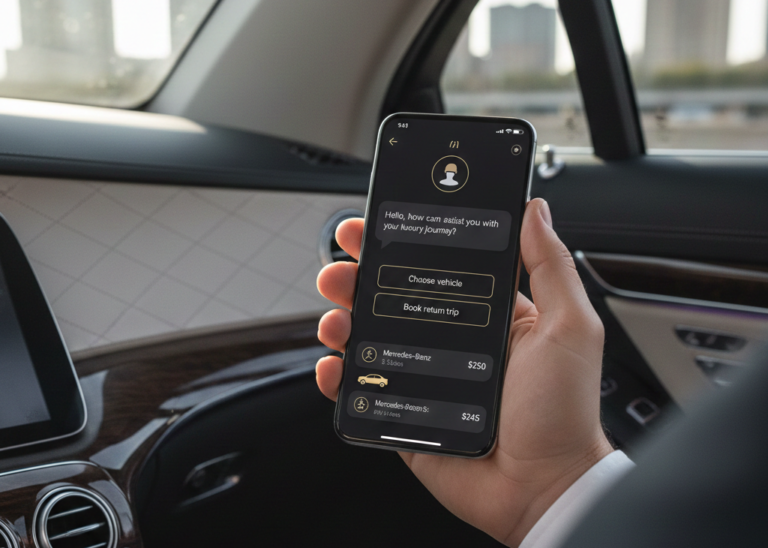
Customers who book via WhatsApp are not doing so because they are technologically unsophisticated. They are doing so because the conversational format is faster, more reassuring, and less cognitively demanding than completing a web form. They send a message: “I need a transfer from the airport to my hotel on Tuesday at 9pm for two people with two large bags.” They receive a response confirming availability, a price, and instructions for payment. The booking is complete in less time than it would have taken them to navigate to the third screen of a standard web checkout.
The lesson is not that operators should abandon their web booking systems in favor of WhatsApp. It is that the conversational booking experience — fast, personal, direct, low-friction — is what customers are trying to find, and the web booking system should aspire to the same qualities.
Mobile-First Is Not Optional
The data on this point has been settled for several years now, but implementation in the private transfer sector continues to lag behind what the numbers demand.
Across the travel sector, the majority of initial searches for ground transportation happen on mobile devices. Depending on the market and the platform, the figure sits somewhere between 60 and 75 percent of total traffic in most regions. The proportion of bookings that complete on mobile is lower — typically in the 40 to 55 percent range — but that gap is not evidence that customers prefer to complete bookings on desktop. It is evidence that many mobile booking experiences are bad enough that customers who started on their phone switch to a laptop to finish the transaction.
Every time a customer has to do that, you are introducing a point at which they might not complete the switch. They get distracted. They forget the website name. They find a competitor in the time it takes them to open their laptop. The transfer operator who built a genuinely fast, genuinely simple mobile checkout is not just winning on user experience metrics. They are winning bookings that their competitors are losing.
The technical requirements for this are well understood: a booking form that renders cleanly on a 375-pixel-wide screen, touch-friendly input fields, no reliance on hover states, calendar pickers that work with thumbs rather than a mouse cursor, and a payment flow that supports mobile-native options like Apple Pay and Google Pay in markets where those are standard expectations. None of this is exotic. All of it requires deliberate investment.
Response Time as a Conversion Factor
For operators who use a hybrid model — online booking forms that route to a human for confirmation before sending a final invoice — response time is as important as form design in determining whether a booking completes.
The research on this, originally developed in the context of B2B sales lead response, translates directly to the private transfer booking context. The probability that a customer will complete a booking after an initial inquiry drops by more than 50 percent if the response takes longer than five minutes. After an hour, the probability drops to a fraction of what it was at the moment of inquiry.
These figures are uncomfortable for operators who process bookings in batches, who check their inquiry inbox twice a day, or who have built their operation around a human response cycle that made sense at lower volumes but has not scaled with growth. The customer who sent a booking inquiry at 11pm and received a response at 9am the following morning has, in most cases, already made other arrangements.
The solutions here range from automated acknowledgment emails with clear response time commitments, to genuinely fast human response during peak inquiry periods, to the kind of real-time responsiveness that a well-managed WhatsApp channel can provide. What does not work is assuming that customers will wait.
A Market Where This Has Made a Measurable Difference
The dynamics described above are relevant in every market where private transfer operators compete for digital bookings. They are particularly acute in markets where the sector is still maturing and where the gap between operators who have invested in booking experience and those who have not is wide.
Albania offers a useful example. A country that has experienced one of the fastest tourism growth rates in Europe over the past several years, Albania presented ground transportation operators with a specific challenge: an international customer base arriving with high expectations for pre-booking capability, in a market that had little established infrastructure for it.
Tirana Airport Shuttle, which has operated private transfers from Tirana International Airport since 2021, built its booking architecture around exactly the principles described in this article. Customers can complete a booking in minutes through a straightforward online form, or message directly via WhatsApp and receive a fast, personal response. Every booking is confirmed by the operations team before a final confirmation is sent, and the response time commitment is taken seriously enough that it functions as an operational priority rather than an aspiration.
The results have been tangible. As the company’s booking volume has grown, the correlation between improvements to the simplicity and speed of the booking process and the completion rate of initiated bookings has been clear. Customers who started a booking and received a fast confirmation completed at a substantially higher rate than those who encountered delays. The WhatsApp channel, managed with the same standards of responsiveness as the online form, became one of the most effective booking sources in the business — not by accident, but because it naturally delivered the low-friction, fast-response experience that customers were seeking.
More details about the company’s approach are available at tiranaairportshuttle.com.
The Confirmation Is Part of the Product
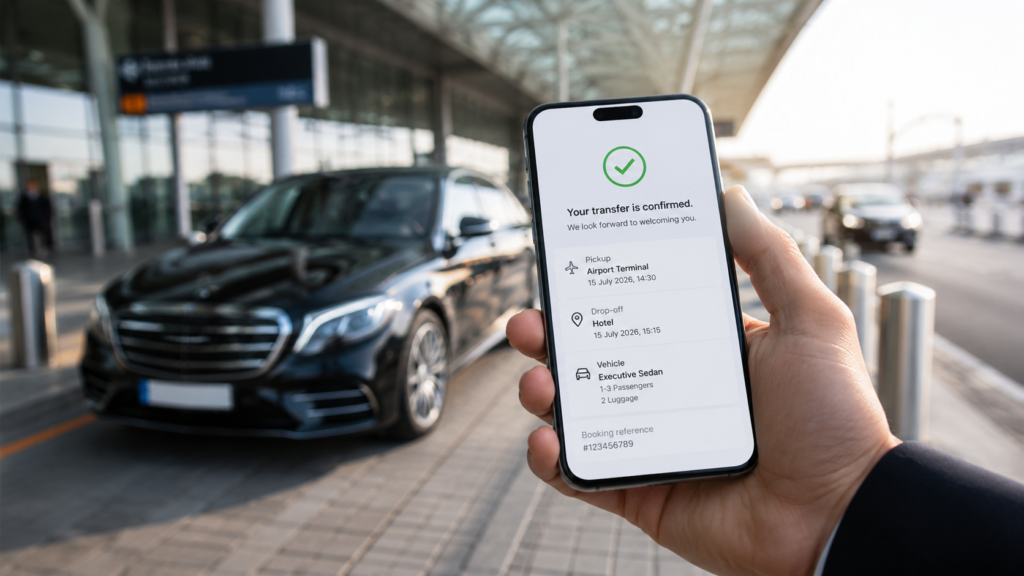
One final point that the industry underestimates consistently: the booking confirmation email or message is not an administrative output. It is part of the product experience.
A customer who has booked an airport transfer has made a purchase that will not be fulfilled for days or weeks. In the interval between the booking and the journey, the only tangible evidence they have that the booking exists and will be honored is the confirmation they received. The quality, clarity, and completeness of that confirmation directly affects their confidence in the operator — and their likelihood of booking again, or recommending the service to someone else.
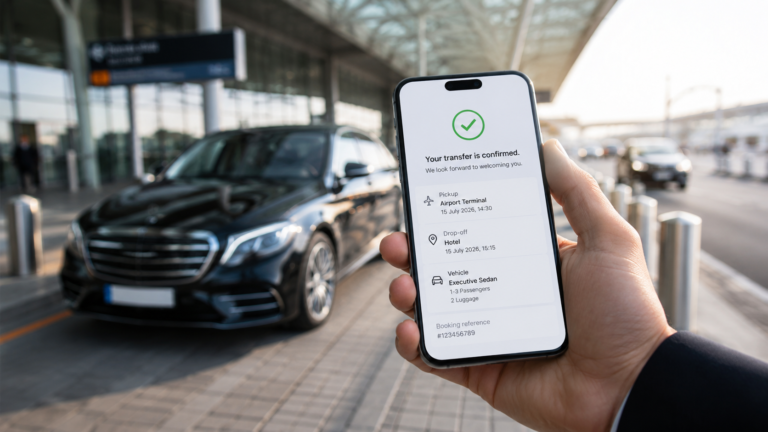
A confirmation that includes the driver’s name, a direct contact number for pre-journey questions, clear information about where and how the driver will meet them, and a reminder of the fixed price they agreed creates a very different customer relationship than a generic automated receipt with a booking reference number. The former reduces the customer’s pre-journey anxiety. The latter often increases it, because it prompts follow-up questions that should have been answered before they needed to be asked.
The operators who treat the confirmation as the last step in a transaction are missing an opportunity. The operators who treat it as the first step in a journey — the moment at which the customer begins to look forward to being picked up rather than worrying about whether they will be — have understood something about their product that goes beyond logistics.
What Getting This Right Is Worth
The business case for investing in booking system quality is straightforward.
If an operator’s current online booking form converts at eight percent of all visitors who reach it, and an investment in simplification and speed brings that to twelve percent, that is a fifty percent increase in bookings without any additional marketing spend, any new routes, or any additional fleet capacity. The cost of improving a booking form is finite and one-time. The revenue effect of a higher conversion rate compounds indefinitely.
The same logic applies to response time investment. If an operator’s current inquiry-to-booking conversion rate is thirty percent, and the primary cause of the seventy percent who do not convert is slow response, the revenue opportunity locked in that gap dwarfs almost any other operational improvement the business could make.
The transfer industry competes on trust, reliability, and professional standards. Those qualities are demonstrated on the journey. But the journey only happens if the booking was completed. And the booking is only completed if the experience of making it was fast, clear, and simple enough to not get in the way.
Three seconds. That is still the window.